

“When I use a word,” Humpty Dumpty said, “it means just what I choose it to mean, neither more nor less.” Lewis Carroll wrote that as a joke about a character who thought language bent to his will. Every contract lawyer has met a real-world version of Humpty Dumpty, except that this one is accidental rather than wilful: it is the defined term that quietly means something different on page forty to what it meant on page four, because nobody told the person doing the translating that the two needed to stay the same thing.
Most translation errors in commercial contracts are not language errors. They are briefing errors: the instructing lawyer assumed precision would follow naturally from a competent translator and a clear source text. It will not, reliably. Here is what an actual brief needs to contain.
A translator who receives sixty pages of a share purchase agreement and nothing else is working blind. They can render every sentence correctly and still misjudge which clause matters most, because they were never told.
Before the document goes anywhere, give the translator the same orientation you would give a junior lawyer joining the matter: who the parties are and what they actually do, what the commercial deal is in plain English, which clauses are heavily negotiated and which are boilerplate, and what is at stake if this document is misread: will it be filed with a regulator, relied on in a dispute, or simply signed and shelved? A translator who knows the indemnity clause was fought over for three weeks will treat its wording with a different level of care than one who assumes it is standard-form filler.
This is the point most lawyers miss entirely, and it is the one that causes the most expensive errors. Translating a contract is not just moving words from one language to another. It is moving concepts between legal systems, and the concepts do not always line up.
Australia operates under common law. Many of the languages you will need translated into or from (French, German, Japanese, Spanish, Indonesian) sit inside civil law traditions built on entirely different foundations. A term like “consideration” has no direct equivalent in a civil law jurisdiction, because civil law contracts do not require it the same way. “Good faith” carries an explicit, codified, and often far more demanding obligation in many civil law systems than the narrower, more contested role it plays in Australian contract law. “Trust,” in the technical equity sense, frequently has no equivalent structure at all in jurisdictions without a law of equity.
A translator who does not know which two legal systems are actually in the room will default to the closest-sounding word. That is how a contract ends up saying something subtly different in each language, which is precisely the outcome a bilingual commercial contract exists to prevent. Tell the translator explicitly: which jurisdiction’s law governs the document, which jurisdiction the counterparty operates under, and whether any term in the source document is doing legal work that will not automatically transfer.
If the contract will be signed in two languages, the brief should say which version controls if they conflict, or whether both are intended to be equally authentic. This changes how the translator should work. Where the English version prevails, the translation exists to help the other side understand it, and the priority is faithfulness to the source. Where both versions carry equal weight, every concept gap of the kind described above has to be resolved deliberately, and agreed by both sides, before signing, because a court may one day have to reconcile the two texts.
Check the counterparty’s jurisdiction on this point too. Some jurisdictions require a local-language version of certain contracts and may give it priority regardless of what the contract itself says.
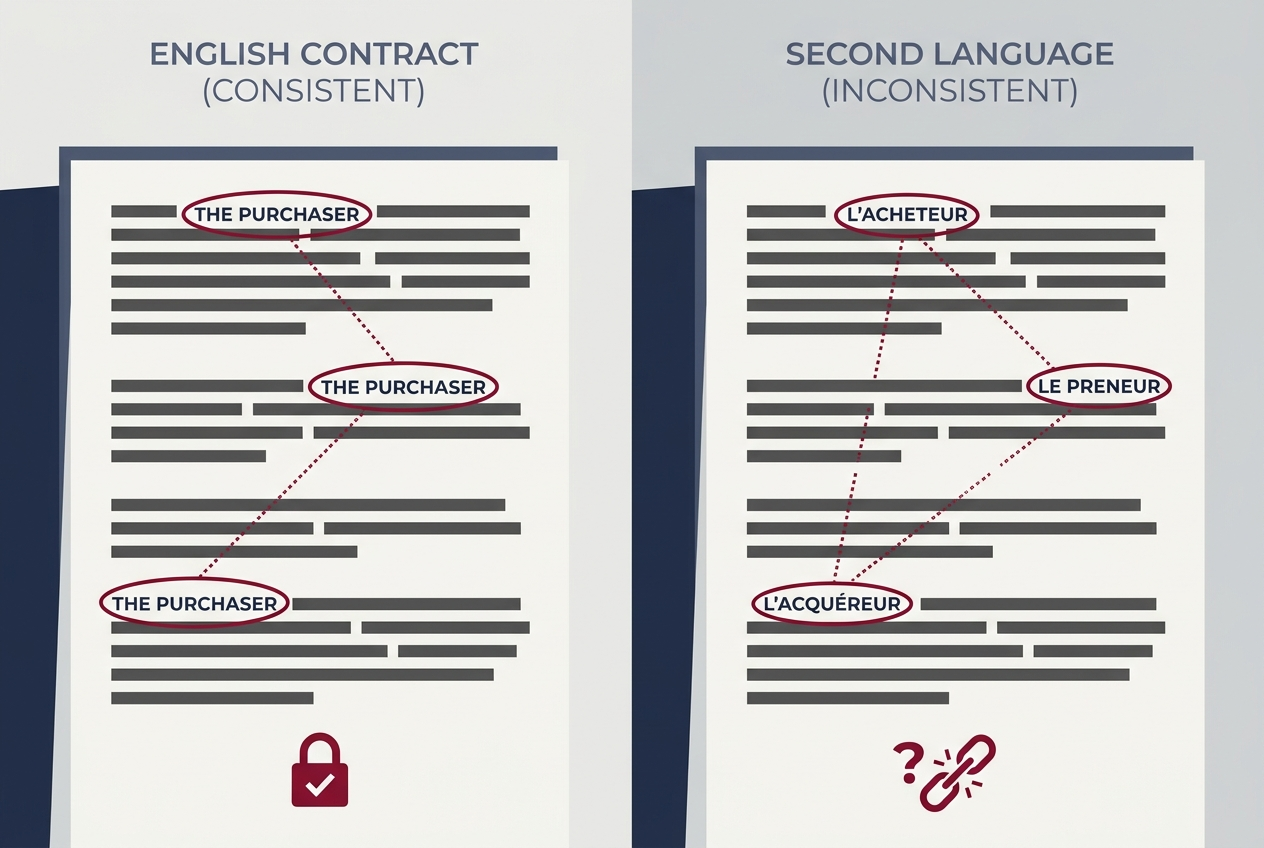
Every contract of any complexity has a definitions clause, and every definitions clause exists to make sure that one word means one thing throughout. That discipline collapses the moment translation starts, unless it is deliberately carried across.
Supply a glossary before translation begins, not after. At minimum, it should list every defined term exactly as capitalised in the source document, the chosen target-language rendering, and a one-line note on any term that is a genuine legal concept rather than an ordinary word (“Material Adverse Effect,” “Affiliate,” “Force Majeure,” and similar). In practice, the translator will often prepare the first draft of the glossary, but the instructing lawyer should review and approve it, because choosing a target-language equivalent for a legal concept is a legal decision as much as a linguistic one. Once the glossary is agreed, the same source term should produce the same target term everywhere it appears in the document: no synonyms, no stylistic variation. Contracts are not prose to be kept interesting. They are logic to be kept consistent, and a translator working without a locked glossary cannot guarantee that consistency across a document they may be translating in sections over several days, or sharing with a second translator.
Not every translation task calling itself “legal” needs the same level of certification, and getting this wrong either wastes money or creates a document that will not be accepted where it needs to go.
A commercial contract being translated for internal understanding, due diligence review, or negotiation purposes generally does not need to be a certified translation. What it needs is a translator with genuine legal subject-matter expertise and, ideally, qualifications or experience in both relevant jurisdictions. A contract that will be filed with a court, a regulator, or a government body, on the other hand, will usually need a certified translation. In Australia, that generally means a translator certified by NAATI, the National Accreditation Authority for Translators and Interpreters. If the document is going to an authority overseas, the requirements may be different again: some jurisdictions accept only a translator sworn or registered locally, and some also require notarisation or an apostille. Ask early which category your document falls into, because building certification into the process after the fact usually means starting the translation again.
Commercial contracts are rarely translated once. If the document is still being negotiated, tell the translator so, and agree upfront how later drafts will arrive. Sending a redline or comparison against the previous version, rather than a fresh clean copy, lets the translator update only the clauses that changed, check them against the agreed glossary, and avoid introducing new inconsistencies into wording that was already settled. Label every version clearly, so that nobody signs a translation of a draft that has since moved on.
The single best predictor of a clean legal translation is not the translator’s fluency. It is whether they were given a channel to ask questions and whether anyone answered them.
Ambiguity that a native-language reader glosses over instinctively is exactly the kind of thing a careful translator will flag, if they have somewhere to flag it. A clause that could plausibly be read two ways, an abbreviation that is not explained anywhere in the document, a cross-reference to a schedule that was not included: these are the things that surface mid-translation, and the brief should say upfront who receives that question and how quickly they will get an answer. A shared query log, recording each question, the answer and the clause it affects, also gives you a record of every interpretive decision made along the way. A translator forced to guess will guess reasonably. Reasonably is not the standard a commercial contract should be held to.
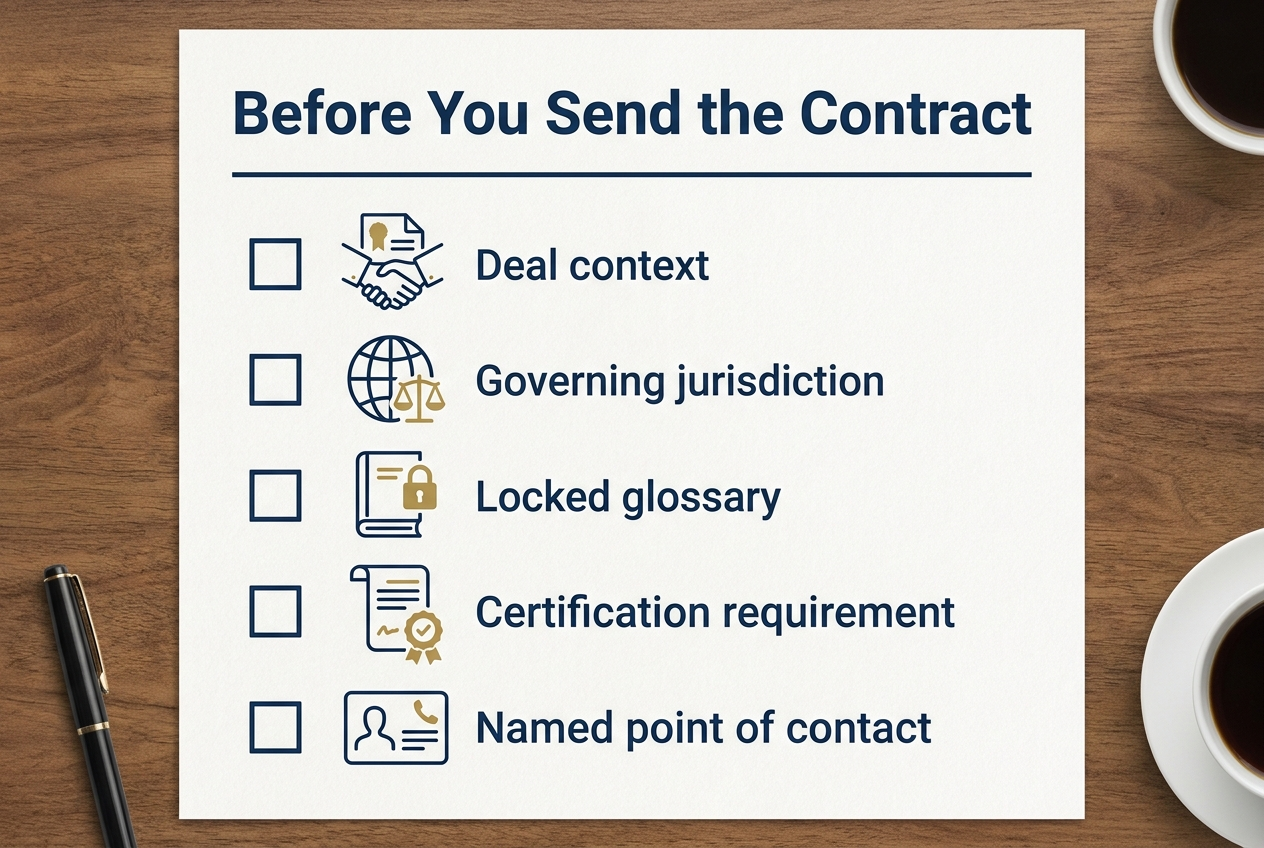
Before the document goes out, check that the brief covers:
None of this is complicated, but all of it takes deliberate effort, because a translator cannot supply context, jurisdiction, consistency, and certification requirements that were never communicated. The lawyers who get the best results are the ones who treat the brief as part of the legal work itself, not as an administrative step that happens after the real thinking is done.
If you are preparing to send a commercial contract for translation, Linguistico works with dual-qualified and legally trained translators across the language pairs that matter most to Australian business and can talk through jurisdictional and certification questions before the document is sent. Explore legal translation services or request a translation quote to get started.