
I wanted to write this one myself, rather than have it read like a company update, because it is a conversation worth having honestly, and it is one I get asked about often: AI, and what it means for translation.
The short answer
We are open to AI. We will not let it replace professional judgement.
Linguistico has provided precise, human-led, NAATI-accredited translation to law firms, government bodies, healthcare providers and other organisations since 2009, starting from a small room on the Northern Beaches of Sydney. We now operate across Australia and the United Kingdom, and in that time we have watched the industry change a great deal.
AI has been the biggest shift of all. Over the past few years we have put AI-generated translation to the test, not as a theory, but in practice, across different platforms and document types. It has improved a lot, and for straightforward, low-risk content, it is a genuinely useful tool.
But how do you know when AI is enough, and when it is not? That is really the question that matters. What happens if a translation is subtly wrong? AI still has limitations when it comes to context, specialised terminology and tone, and it can be inconsistent even within a single document.
This is not a small caveat. There are now documented cases in Australia where AI-generated hallucinations have made their way into legal proceedings. In one recent case, a lawyer used AI to identify Australian case law, only to discover that the system had generated cases and quotations that did not exist. The material had been filed with the court before the errors were identified, and the matter was referred to the relevant legal regulator.
The risk is not theoretical, and it looks different depending on where you sit.
For legal work, a mistranslated word can change the meaning of an argument, or worse, be filed with a court. Pleadings, contracts, witness statements and case law leave no room for a subtle error.
For healthcare, a subtly wrong translation of a dosage instruction, a consent form or a discharge summary is not a minor inconvenience. It is a patient safety issue, and the kind of error that can end up in a formal complaint or a regulatory review well after the fact.
For government and public sector work, accuracy is not a preference, it is a compliance requirement. Public-facing and regulatory documents carry accountability that a subtly wrong translation can quietly undermine long after it has gone out.
In all three, a small error is never a minor inconvenience. And unlike a professional human translation, an AI output does not come with professional accountability. There is no qualified translator who has reviewed the work, taken responsibility for its accuracy and, where applicable, certified it.
We are not anti-AI. We simply do not believe that everything should be automated because it can be.
To make this practical, we use a simple three-tier test:
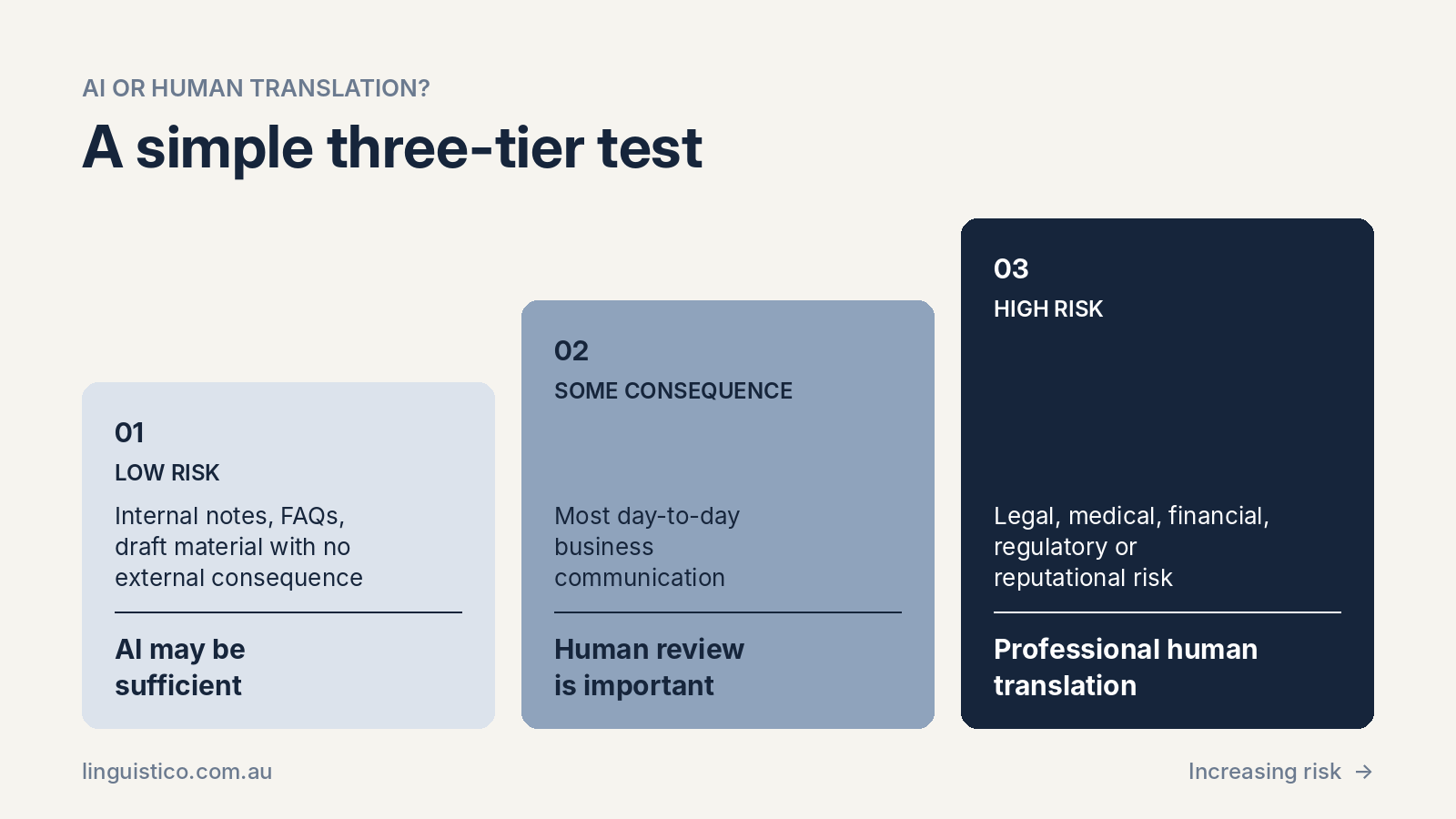
As more routine translation becomes automated, the value of specialist, accountable human translation does not shrink. It becomes more clearly defined. The work that remains for professional translators is, almost by definition, the work that carries the most weight.
This is where we stand. AI can support the translation process, but it cannot be the process, not for the work that carries real risk. Every document that leaves Linguistico under our name is completed and taken responsibility for by an experienced human professional, independently reviewed, and NAATI certified where appropriate. For legal pleadings, contracts and witness statements, for patient-facing and clinical documents, and for public-facing and regulatory material, that will not change. Not because we are resistant to progress, but because it is what the standard genuinely requires.
What is on your desk right now that cannot afford to be even slightly wrong?
If you would like to talk through your requirements, get in touch with our team. I am always happy to have an honest conversation about what level of professional translation is appropriate for your particular needs, and to help you determine the best approach for your project.
Warmly,
Adrienne
Co-Founder, Linguistico