
The honest answer is that Home Affairs does not publish a short list of documents that require NAATI translation. Its general rule is broader: any document that is not in English needs to be translated into English, and if the translation is done in Australia, it must include the translator’s NAATI practitioner number. In practice, that means birth certificates, marriage certificates, police certificates, education records and any other foreign-language evidence you rely on all need translation, and a NAATI certified translator is the safe way to do it from inside Australia.
This guide explains what the rule says, which documents commonly need translating, what to check on a finished translation, and where requirements differ between visas and other bodies. It is general information, not migration advice. For advice on your visa, speak to a registered migration agent or lawyer.
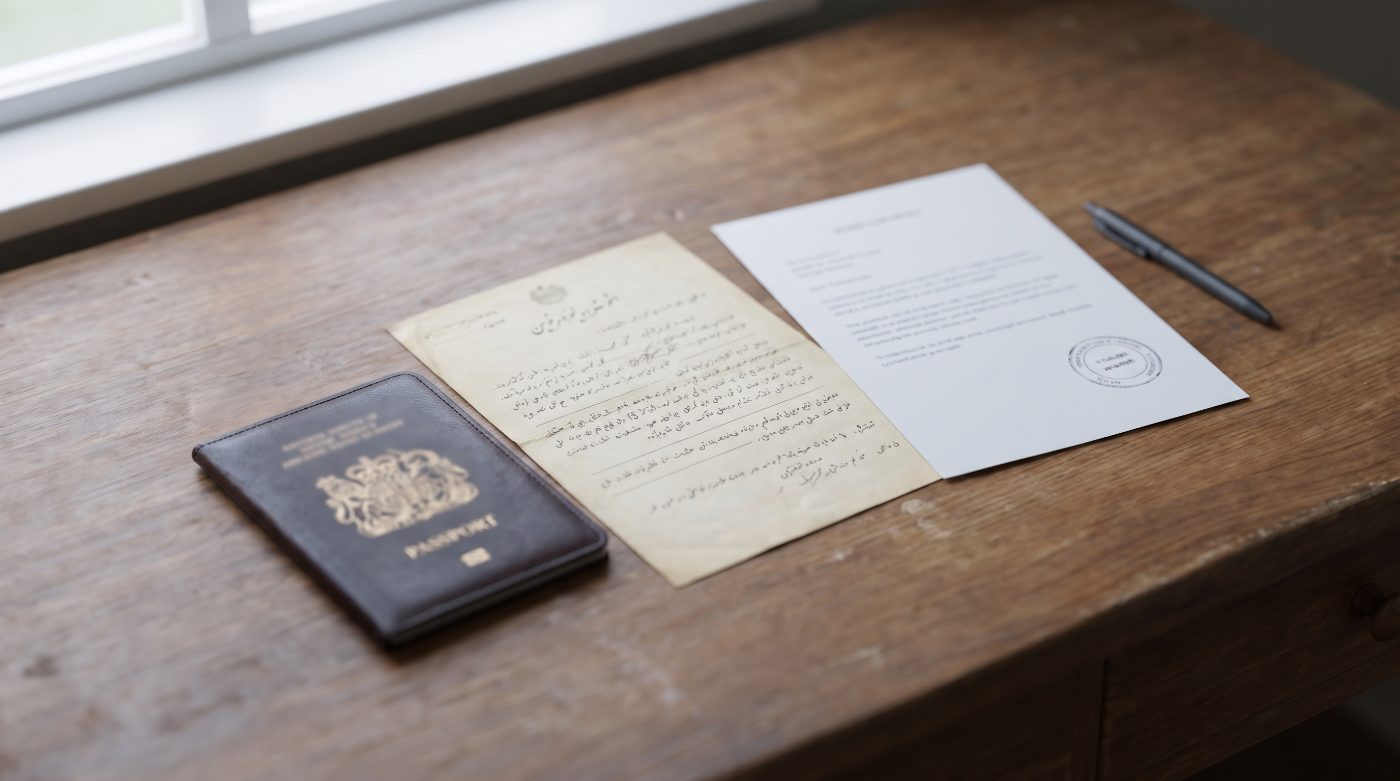
What Home Affairs actually requires
Home Affairs’ guidance for skilled visa applicants sets out the baseline. According to its skilled visa application checklist, you should translate all non-English documents into English, and:
- If translated in Australia: include the translator’s NAATI practitioner number.
- If translated outside Australia: include the translator’s full name, address, phone number and qualifications in the language they are translating.
- For Police certificates: if a police certificate is not in English, you must also give a certified copy of the translation.
The same instructions appear in Home Affairs’ general check twice, submit once guidance. Specific visas can add their own conditions. For example, Home Affairs’ identity requirements for protection visa applicants say identity documents not in English need certified English translations from a NAATI-accredited translator, at the applicant’s own expense. Always check the page and checklist for your own visa subclass.
Two points are easy to miss:
- The rule is about language, not document type. If it is not in English and you are relying on it, translate it.
- A certified copy and a certified translation are different things. A certified copy is a copy of a document that an authorised person has certified. A NAATI certified translation is a translation by a certified translator. Some situations call for both, such as a non-English police certificate.
What “NAATI certified” means
NAATI is the national standards body for translators and interpreters in Australia. According to NAATI’s practitioner identification page, every NAATI certified translator receives a Certified Practitioner Number (CPN), a nine-character number beginning with “CPN”, and a stamp, physical or digital, used to certify their translations.
Useful facts from NAATI:
- A physical stamp shows a translation date and a “valid to” date. The “valid to” date relates to the translator’s credential, not to the translation, which does not expire.
- A digital stamp carries a unique QR code that can be scanned to verify it.
- NAATI’s FAQ notes that most government agencies in Australia require documents to be translated by someone who holds NAATI certification, and that it is always up to the client what they accept.
That last point matters. NAATI does not decide what Home Affairs, a university or a licensing body will accept. Each of them sets its own rules.
Documents that commonly need translation
The list below is not an official Home Affairs list. It shows documents that are commonly part of visa applications and often need translating if they are not in English. Whether you must provide each one depends on your visa.
| Document | Why it is often needed | Notes |
| Birth certificate | Identity, relationship to children or parents | Translate all fields, including stamps and handwritten notes |
| Marriage certificate | Relationship evidence | Include any attached registration pages |
| Divorce or death certificate | Marital history | Needed where it supports your claims |
| Police certificate | Character requirements | Home Affairs asks for a certified copy of the translation |
| National ID card or family register | Identity | Check which pages are needed |
| Passport biodata page | Identity | Needed if it is not in English or the translation is relied on |
| Academic transcripts and degrees | Skills and education claims | Skills assessing bodies may have their own rules |
| Employment references and payslips | Work experience | Translate any letters, contracts and payslips you submit |
| Relationship evidence | Partner and family visas | Messages, bank records and statements not in English |
| Medical or other reports | Health or other claims | Translate anything you submit in another language |
If you are not sure whether a document is needed, check your visa’s checklist, or ask your migration agent or lawyer, before you pay for translation.
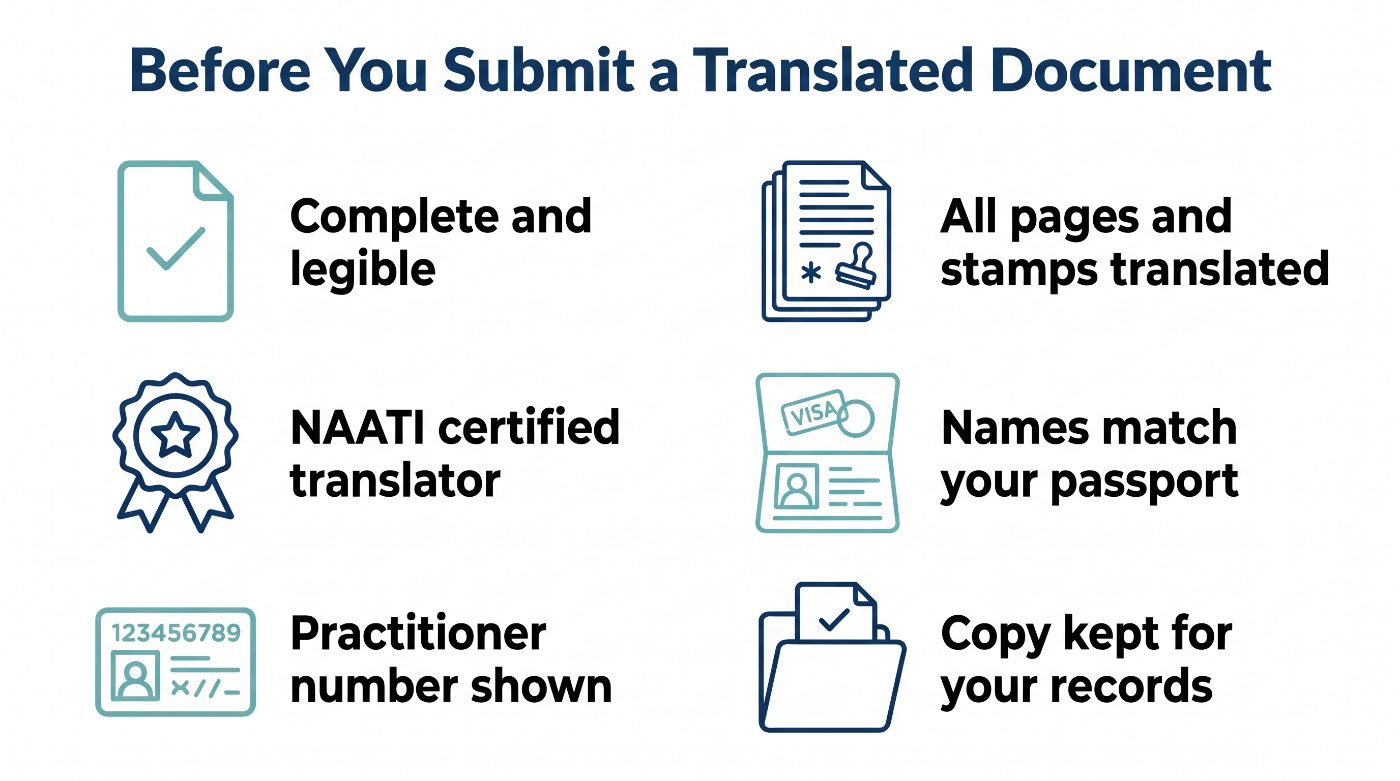
What to check on a finished translation
Before you upload anything, check:
- Practitioner number. For translations done in Australia, Home Affairs asks for the translator’s NAATI practitioner number. Make sure it is on the translation.
- Stamp. NAATI certified translators certify their translations with a stamp. Confirm there is one and that the details are legible.
- Completeness. Every page, stamp, seal, annotation and handwritten note should be translated or described, not just the typed text.
- Names and dates. Spellings should match your passport. Differences can raise questions later, so ask the translator to follow the passport spelling and flag any inconsistencies.
- The original is attached or referenced. Keep the original with the translation so the two can be compared.
How to check a translator
You can check a translator’s credentials yourself. The NAATI Online Directory lets you enter a Certified Practitioner Number and see whether the certification is verified, along with the translator’s name and location. NAATI notes that a translation completed while the translator’s certification was active remains valid indefinitely, and that for an expired credential it can’t confirm the practitioner meets current standards. Practitioners with purely numerical numbers hold older accreditations, which NAATI says it can verify by email.
Common mistakes
- Using a friend or relative. Home Affairs’ practitioner-number requirement means a translation from someone who isn’t NAATI certified is a risk if you are translating in Australia.
- Translating only part of a document. Partial translations can leave gaps that cause delays.
- Assuming one rule fits everybody. Skills assessing authorities, professional boards and universities can have their own requirements. Check each one.
- Leaving it late. Translation takes time, and documents may need several languages and pages. Start early.
- Treating the translator as a visa adviser. Translators translate. They can’t advise on which documents your visa needs. Immigration assistance is regulated in Australia, so see the MARA’s guide to giving immigration assistance and use a registered migration agent or lawyer for advice.
Where Linguistico fits
Linguistico provides NAATI translation for migration and official purposes. Every project is handled by a NAATI-certified translator and checked by an independent second reviewer, and the entire process is completed online. We offer translation in over 90 languages, with quotes provided on request, and you can meet our translators and see our languages. Our NAATI translation page explains the service, and our government translation page covers translation for government use. When you request a quote, tell us the visa, the receiving body and the deadline, so we can match the translation to what you need.
Frequently asked questions
Which documents need NAATI translation for an Australian visa?
Home Affairs’ general rule is that all non-English documents must be translated into English, and translations done in Australia need the translator’s NAATI practitioner number. Common examples include birth and marriage certificates, police certificates, education records and relationship evidence. Check your own visa’s checklist.
Does Home Affairs require a NAATI certified translation?
For translations done in Australia, Home Affairs asks for the translator’s NAATI practitioner number. For translations done outside Australia, it asks for the translator’s name, address, phone number and qualifications. Some visas, such as protection visas, specify NAATI translators for identity documents.
Do I need a certified copy as well as a translation?
Sometimes. For a police certificate not in English, Home Affairs asks for a certified copy of the translation. For other documents, check your visa checklist. For protection visas, certified copies are not needed if documents are submitted online in ImmiAccount.
Does a NAATI translation expire?
NAATI says translations do not expire. The “valid to” date on a stamp relates to the translator’s credential, not the translation.
Can I translate my own documents?
If you are applying with translations done in Australia, Home Affairs asks for a NAATI practitioner number, so a self-translation is unlikely to meet the requirement. Check your visa’s guidance and speak to a migration agent or lawyer.
How do I check my translator is NAATI certified?
Use the NAATI Online Directory and enter the translator’s Certified Practitioner Number, which is shown on their stamp.
Can Linguistico advise on which documents my visa needs?
No. We translate documents. We would love to help with your translations, however we are not able to advise on visa applications. Speak to a registered migration agent or lawyer, who will be happy to guide you.
Get a quote for your documents
Send us your documents, the languages and your deadline for a quote. Request a translation quote, visit our home page, or call (02) 9220 1700.
This article provides general information and is not migration, legal or financial advice. Visa requirements change and differ between visa types and receiving bodies, so check the current Home Affairs requirements for your visa and speak to a registered migration agent or lawyer about your application.